Bonafide Farm

Finally! Broody hens!

June 17th, 2013 § 0

Ever since April I’ve been hoping one of my hens would go broody and hatch some chicks. Why? Because baby chicks are some of the things that make life worth living, of course. That and I am seriously curious to see what kind of crosses would result from my Wheaten Ameraucana rooster over Black Copper Marans, Lavender Orpingtons, a Barred Olive Egger, and whatever mix Lilac and Iris are (Black Australorps and Mottled Java, according to their breeder).* Iris and Lilac are in their second year of lay, and it’s good to have younger pullets coming along to take over egg-laying duties. And finally, now that I am free-ranging the birds outside most days, I anticipate that at some point I will have predator loss and don’t want to be caught out with not enough laying hens to keep eggs in the fridge.

A broody hen is a wonderful creature because she manages all the care, feeding, and warming of young chicks. If you have ever raised chicks, you know that it’s a big, messy job to monitor their brooder temperature, clean up after them, keep them safe from drafts and predators, and make sure they get enough to drink and eat. So I told myself that the only way I would raise chicks this year was if a hen did all the work for me!

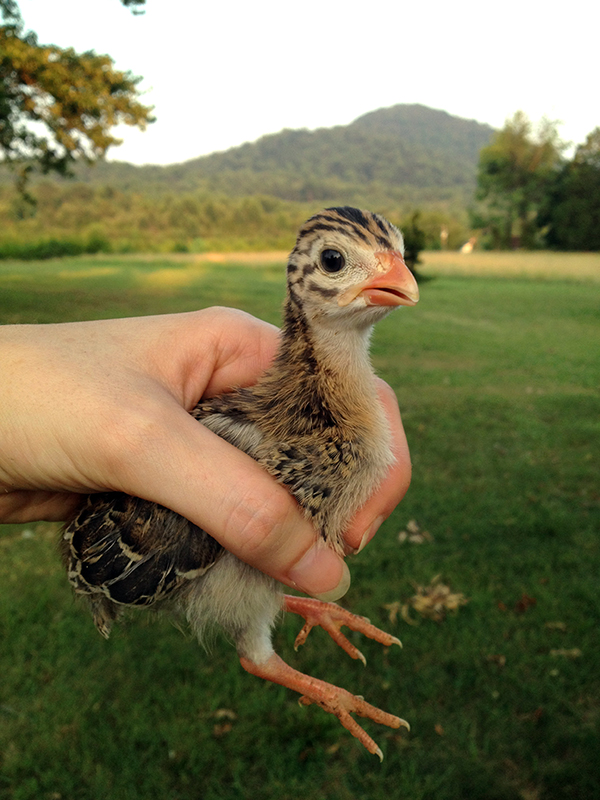
Last year Iris went unbreakably broody and I ended up giving her a clutch of fertile guinea eggs. She brooded them in a dog crate in the garage and hatched out and raised nine guineas. Here’s one at several weeks old, posing for its CraigsList portrait:
KeetWeb

I got to watch the hatch and meet the still-damp keets, and it was one of the neatest days of my life. But this year, Iris has chosen to not do it again. Being trapped in a small cage with nine flighty, frantic, velociraptor-looking guinea keets was probably enough for her to sign off on motherhood forever. Not that I blame her—check out how those ravenous minidinosaurs are eying up their adopted mother’s toes while Iris pleads with her eyes for a Calgon moment.
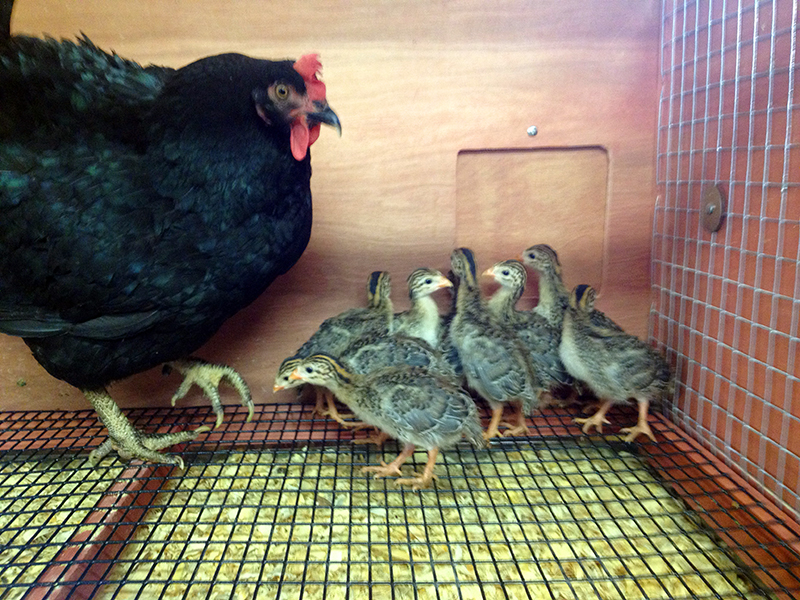
Iris KeetsWeb

The most time-tested way to induce broodiness in a hen is to let eggs accumulate in the nest box. When the hen feels a growing clutch beneath her, some hormone switches in her brain that tells her to buckle down and brood. She will remain on the nest, barely eating and drinking, and will often pull feathers out of her breast so that she can keep the eggs tucked right next to her bare skin.

For weeks now I’ve been letting eggs accumulate, rotating out the older ones after a day or two in order to keep some in the fridge. I also placed the infamous glass eggs in the nests to trick the hens in to thinking there were always eggs waiting for a mother. And finally, it started to look like a few of then hens were beginning to feel broody.

Oregano, my beautiful barred olive egger, was the first to show any sort of devotion. After she’d been on the nest about a week, I fixed up a broody coop in the garage and built her a cardboard brood nest. It’s best to have a hen incubate eggs and raise chicks in a quiet, private place away from the bustle of the main coop, where flock mates may see new babies as tasty hors d’oeuvres. I was waiting for nightfall to move her to her new home when one of my Black Copper Marans saw the nest was exposed and jumped up to sit on the eggs.
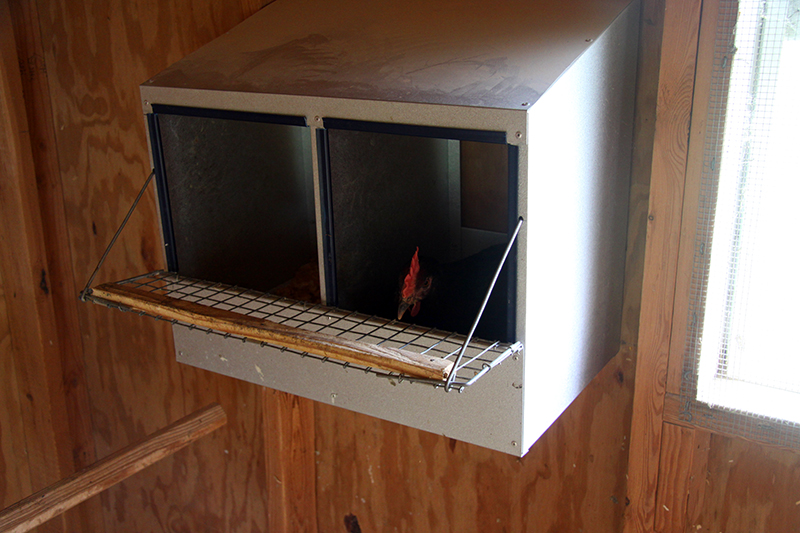
IMG_3198Web

After dark, when I went to collect Oregano, the Black Copper Marans was still sitting tight on the eggs. One look and I got her message: She wanted a clutch of her own.
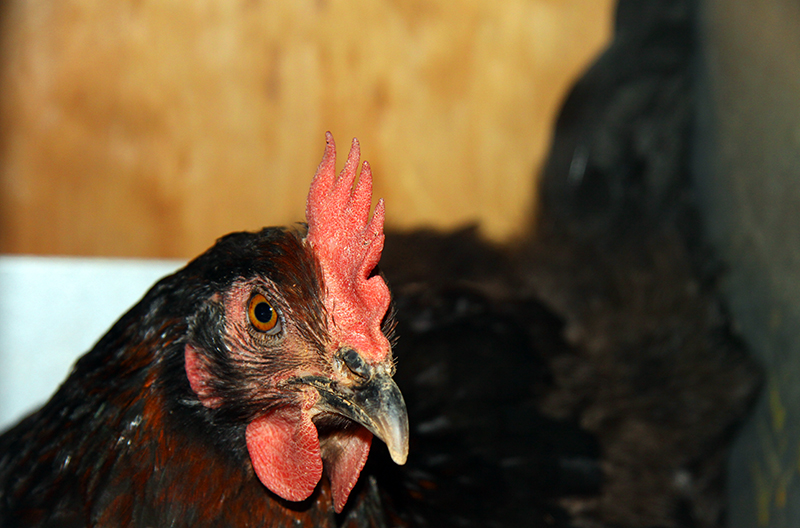
IMG_3204Web

Oregano had assumed a broody position in the adjoining nest box. So I grabbed her and moved her and the eggs into the garage coop.
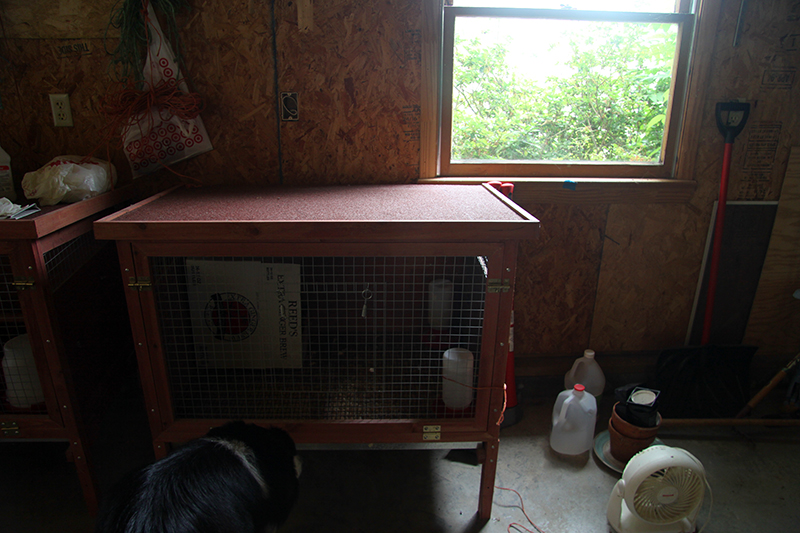
IMG_3222Web

Oregano accepted her new nest and has stayed on it since Friday.
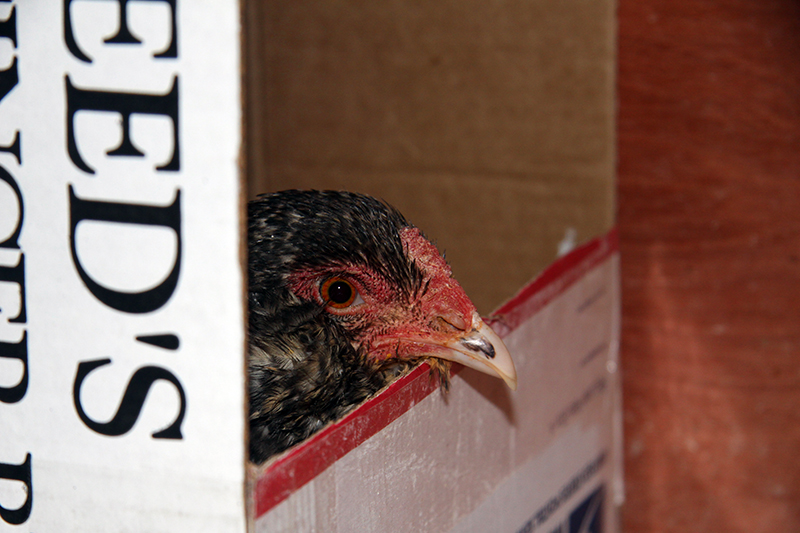
IMG_3220Web

But the Black Copper Marans was still sitting on the glass eggs. And so I fixed up a second broody coop in the garage, built another cardboard next box, and last night moved her into a brood cage next to Oregano. So now I have two broody hens.

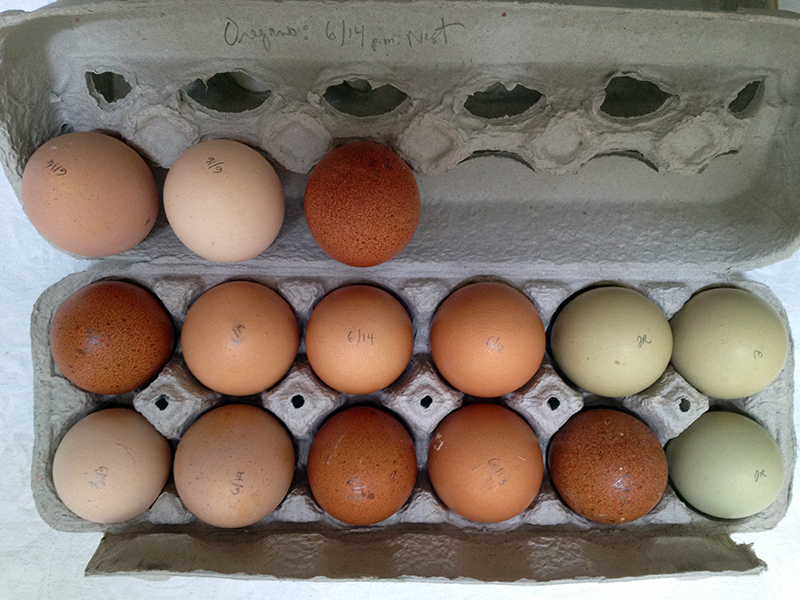
I have been saving out eggs for a week or so now, and when I get numbers I am satisfied with I will remove the glass and sacrificial eggs from under the hens and replace them with these fresh eggs. That way all embryos will start to develop at once, and all chicks will hatch at the same time. It’s a bit sad as the eggs are developing under Oregano, but their job really is to just “hold” the hen in a broody mindset until the more valuable eggs are introduced.
EggsWeb

I wasn’t really planning on trying to raise two clutches, but at the end of the day it’s not such a bad thing. It means I can hatch more eggs, which is good as there is no way of knowing what the fertility rate is amongst my hens’ eggs. And, if one of the hens begins incubating and gives up, I could move the most valuable eggs to the other hen and have her take over. Thus, I am waiting until the same night to give both hens their eggs, and then we will see what happens! There is still a lot that can go wrong in the 21 days it takes to cook a chick, but I am having fun working with my broodies. If you’d like to know more, allow me to refer you to this excellent article by my favorite author on all things chicken, Harvey Ussery: Working with Broody Hens.

*A quick digression on chicken breeds and egg color: I have the right set-up to produce olive eggers, which, as their name suggests, lay olive colored eggs. To make a nice olive egger, you need a dark brown egg-laying breed (such as Black Copper Marans) mixed with a blue egg laying breed (Wheaten Ameraucana—my rooster). My Black Copper Marans don’t lay very dark eggs and I have no idea what sort of blue egg genetics my rooster carries, so I don’t suspect I will break any records with any pullets I hatch from that combination. But at the very least, I should end up with some sort of green egg, which is plenty exciting to me.

Now here is where it gets interesting. I have three eggs saved out from Oregano, my barred olive egger (the green eggs in the photo above). She does lay a very nice olive-colored egg, when she lays. By crossing her with Calabrese, and his blue egg genes, I may end up with a pullet that lays a really green egg, as opposed to an olive egg. But who knows, really? I have read about chicken genetics until I fell over from confusion and still am not sure what will happen. Mostly because I know nothing about the genetics of the birds I am starting with, other than their supposed breeds and what color eggs the hens lay now. And there’s always the possibility that I will hatch 100% cockerels and then the whole experiment is good for nothing but the freezer. And even if I do hatch pullets, it will be another year until they lay and who knows if I will even be in to chickens then!
This year’s tomatoes

June 16th, 2013 § 4

We now move in to the tomato patch, a topic deserving of its own post.

IMG_3075Web

This year I got most of my seedlings from the Piedmont Master Gardener’s Plant Sale. I bought a bunch of heirlooms, including:

Constoluto Genovese
Black Cherry
Ponderosa Red
Orange Oxheart
Mr. Stripey (the only tomato of these I’ve grown before, and a favorite)
Mortgage Lifter
Green Zebra
Amish Paste
Sun Sugar (a deviation from last year’s Sun Gold, which though delicious split too much for my liking)
Abraham Lincoln

I chose these heirlooms because for the past few years I have grown mostly big-box store hybrids, and I haven’t been wowed by their taste. So this is an attempt at a fantastic tomato even though I know I am running the risk that these less-disease resistant varieties might be struck down before bearing fruit. But I also hedged my bets a bit by planting two hybrids: New Girl and Big Beef.

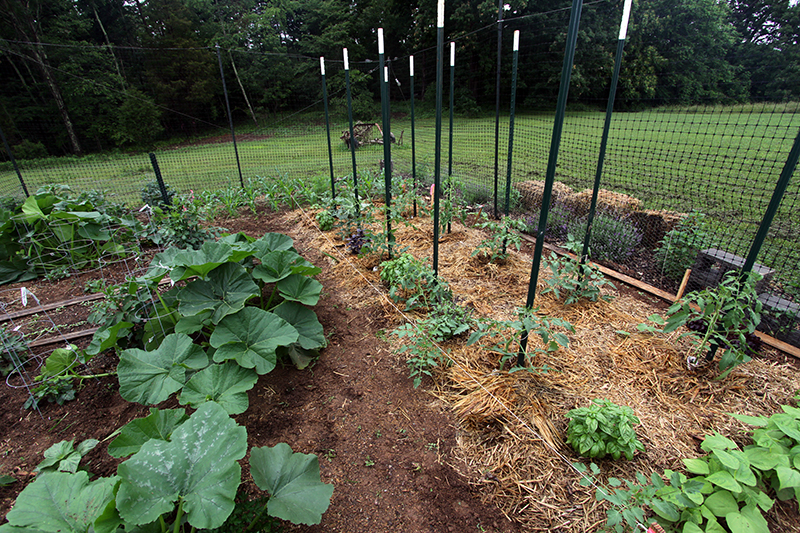
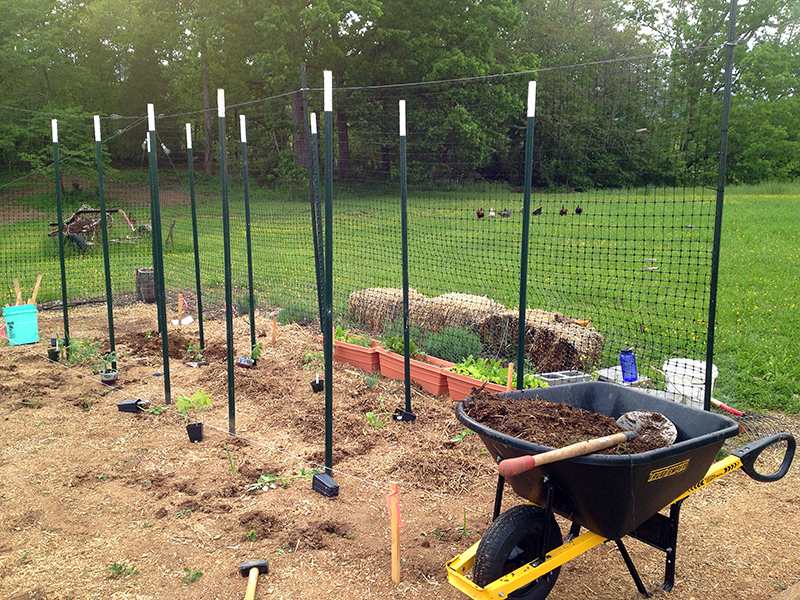
The worst day of spring gardening is the day I put in the tomato stakes. These are heavy eight-foot fencing posts. Installing each means I climb on a ladder and balance, trying not to tip forward and impale myself while using a sledgehammer to drive each post in the ground. This year, as usual, I ended up with a black-and-blue left hand—the victim of each missed strike. And there are many while sledgehammering at the top of a ladder.

But once the stakes were in, and after a few days of recovery, comes one of the best spring gardening days: planting the tomatoes. I did every thing I could to give my plants the best possible start, including amending each planting hole with two gallons of home made compost, a tip I picked up from this Mother Earth News article:

Unless you planted some vetch in early fall, simply mix about two gallons of compost into each planting hole. In a tomato trial at Iowa State University, compost increased overall yields by 40 percent, while early yields shot up by more than 200 percent.

I searched for but wasn’t able to find the cited Iowa State study. I went ahead with the advice anyway as an experiment.

TomatoCompostWeb

The plants had grown so leggy that some of them got as much as a foot of stem buried during planting.

TomatoHoleWeb

The buried stems grow roots and help anchor the plant more firmly in the ground. But don’t try this with just any plant—burying most plants this deep will mean certain death (for the plant!)

After each plant was tucked deep in its compost nest I circled each stem with aluminum foil, as I always do to ward off cutworm damage. It was cold and all the plants looked peaked as they transitioned to full-sun and through transplant shock. I realized they weren’t well hardened off, and so I shaded them with boxes and gave them extra water. Then I went to the beach for eight days and worried about them all the while. But when I came back it looked like most had taken hold and were doing well. The only one that looked poor was Green Zebra, and that’s my fault for breaking its rootball while planting it. I kept it in the ground and stuck the Big Beef in next to it.

And now they’re all doing great and we’ve transitioned into the normal maintenance routine which means pinching out suckers and tying each vine to the post as it grows. Most plants have already set flowers, which is a sign that their compost beds aren’t too rich for their liking—a good thing.

I remain hyper-aware to signs of disease, and have taken a few steps to help prevent it. After the soil warmed up, I heavily mulched around each plant with straw. This keeps soil from splashing on the plant leaves when it rains, and cuts down on disease transmission from soil-borne pathogens. I have also removed any lower leaves that touch the soil with the same idea in mind. It’s a hard call to make, as those leaves shade the stem during the hottest part of summer, but any way to keep the dirt off the leaves helps reduce infections.

With all this preparation, and a hefty dose of luck, I hope to have a few good tomatoes this year. Stay tuned!


Birds on a wire

June 15th, 2013 § 2

Thursday night I was putting the chickens to bed and looked up to see all five baby bluebirds from the first hatch sitting on the garden fence. It was pretty awesome. They stuck around long enough for me to grab my phone and take this shot, which isn’t great because it was almost dark. But they’re there, and still all together!

BluebirdsonWireWeb

It was wonderful to see them all doing so well.

Then, as I was making my tea Friday morning I looked out to see blue feathers in the grass by the porch. My heart sank. It’s amazing to me how around here joy can turn to sorrow with just the sight of feathers on the ground.

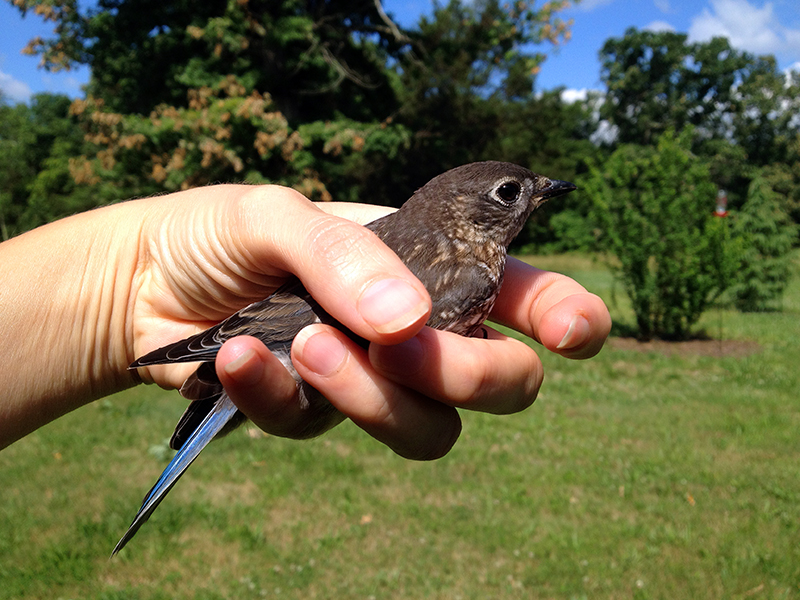
I went outside and found this little gal (?) I think she flew into the glass panel at the bottom of the porch.

BluebirdGrassWeb

She wasn’t dead, but her legs looked a little crumpled. I picked her up to make sure they weren’t.

BluebirdinHandWeb

She did that thing birds do where she closed her eyes and deflated, a sign I know as shock and a leap toward death. So I quickly put her back down in the grass and ran in the house for some rescue remedy. I dribbled a few drops on her head and retreated to watch her through the window. In about a minute her closed eyes opened and she picked up her head to look around. It was a 180 degree turn. I was preparing a tiny bowl of water for her when she jumped up and flew off in the direction of her old nest box. Her dad flew out from attending to his second family. The little girl perched in the base of an evergreen, and when I checked back a few minutes later, she had flown away.

Golden armor

June 14th, 2013 § 0

[Written last night, but not posted before the internet cut out from the wind.]

It was a strange day. Spent all last night and today waiting for a predicted severe weather event that never happened, at least not here. A magical, beautiful package arrived, and I did lots of reading about unseen forces, struggling with suspension of disbelief versus emotional intelligence and things I see right in front of me clear as day. Change is afoot in this house, and I welcome it.

IMG_3162AWeb2

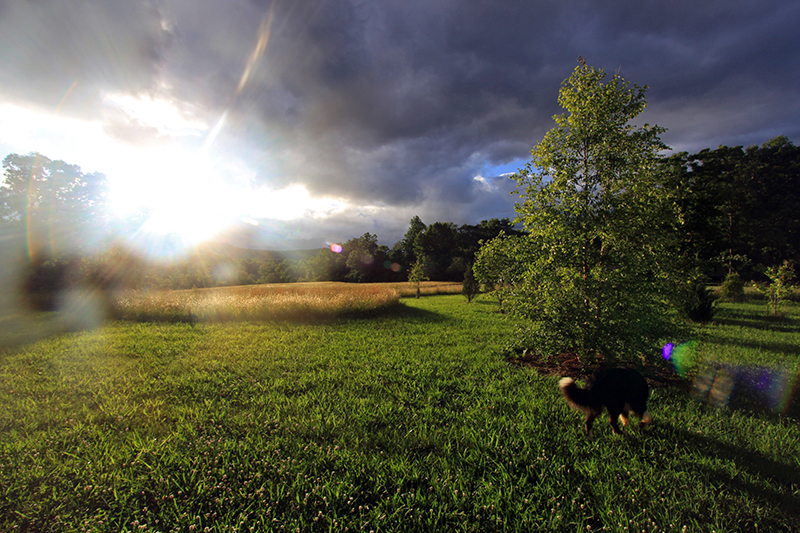
I looked up around 7:30 this evening to see the most golden light I’ve ever experienced here flooding the yard. Each clover in the lawn was aglow. Of course I ran to it with the camera and this is what I came away with in the minute and and twelve seconds it was alive. Tucker was nosing around next to me. Maybe that’s a lens flare, maybe it’s his aura? Purple and green, the head and the heart, spirituality and nature.

Now it’s very windy as a cold front, maybe more, comes through, and the lights and internet connection keep flicking off and on. I hear the branches tossing outside, and it sounds like the ocean.

Early June vegetable garden tour: Part two

June 14th, 2013 § 0

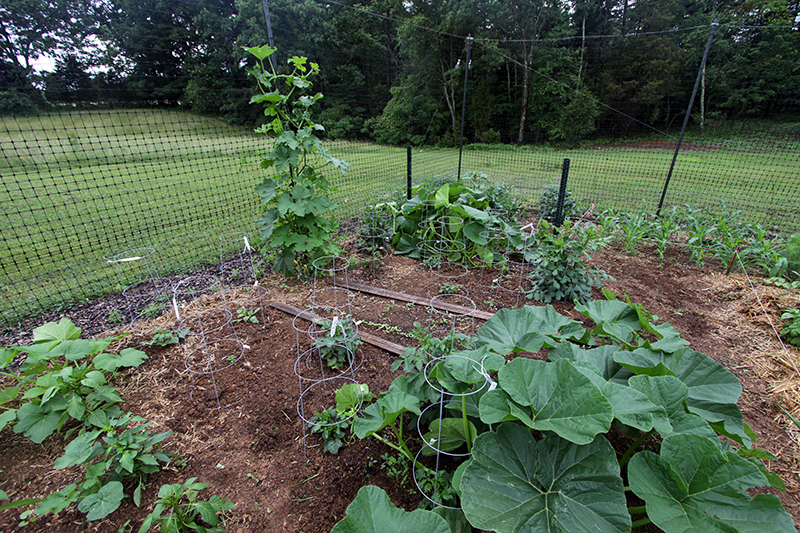
The garden tour continues with a pepper patch, in the foreground below, some dahlias, and giant volunteer pumpkin. I couldn’t figure out where all the pumpkins were coming from, as I’ve never successfully grown any in my garden. And then I remembered that all last winter I split my Halloween pumpkins open and fed them to the chickens as they were penned in the garden. A ha!

IMG_3076Web

It was a tough call, but I just ripped out all the volunteer pumpkins. I’d love to grow them, but I just don’t have the space. It’s only June and the vines were already overtaking the garden, shading plants I actually am trying to cultivate (like the dahlias). So out they came.

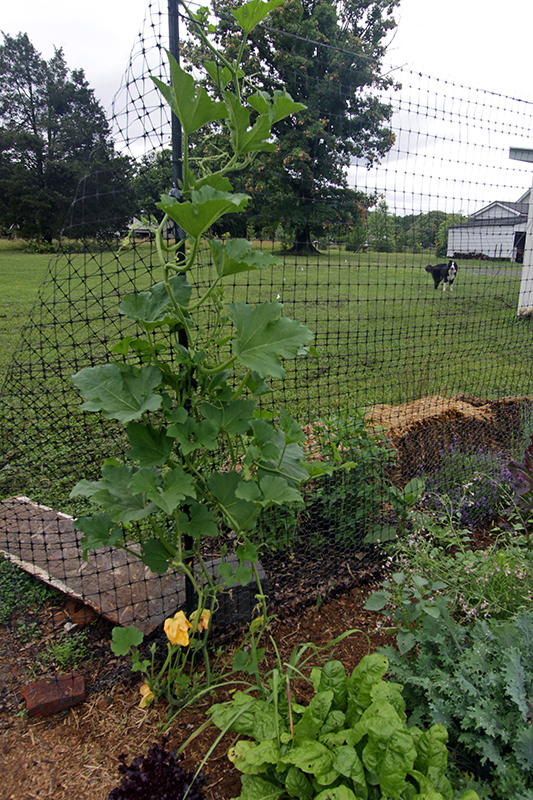
You can also see my squash experiment, above, growing up a post. Ever since I’ve had this garden I’ve battled squash bugs, which have always killed my vines about the time they set their first fruit. This year I said no more squash—too much a waste of resources and space for something that’s bound to die and also cheap to buy in the grocery. Then I came across something that suggested growing squash vertically, as the squash bugs multiply more rapidly when hiding under leaves near the ground. So I used these volunteer squash plants as guinea pigs, tying them up the posts with strips of plastic bag and trimming off the leaves closest to the ground. Despite seeing (and killing) just a handful of squash bugs, the vine below has already succumbed to something. Le sigh. The vegetable that most people can’t give away fast enough eludes me. I think I will do a post-mortem and cut open the stem looking for squash vine borers.

IMG_3080Web

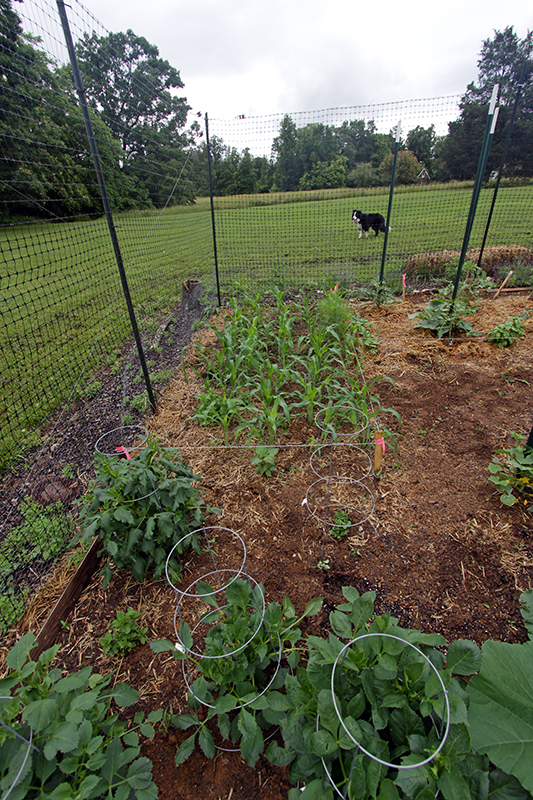
My little “Glass Gem” corn patch is doing well. The stalks have about doubled in the days since taking this photo. The several inches of rain we’ve had in the last week are working wonders in the gardens. More caged dahlias, too, just budding out. The trick of starting them in pots in April has really worked—they are many weeks ahead of where they were last year when started in the ground.

IMG_3077Web

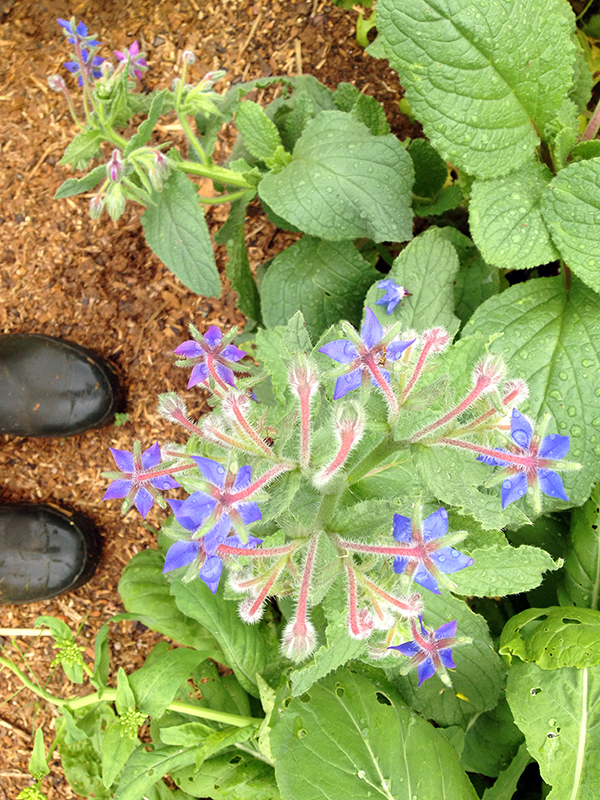
One of my new favorite plants, borage, below. I don’t know why, but I am so drawn to this plant that it’s kind of nuts. It has wide, fuzzy leaves that taste just like cucumber. 

BorageBootsWeb

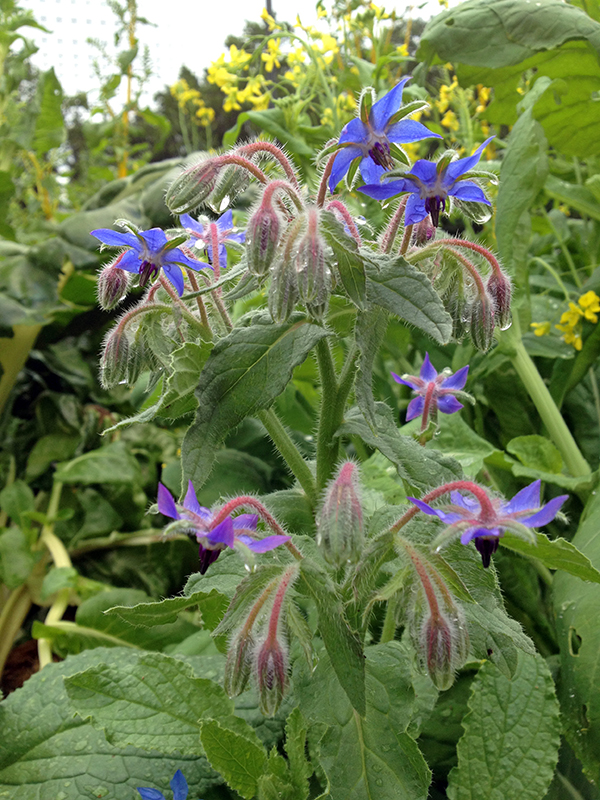
That was exciting enough for me, but then I planted it out and it pulled this trick—blooming with one of the most lovely flowers I’ve seen. There’s something magical about this plant for me. I am just waiting to learn from it.

BorageMustardWeb

A better shot of my new dahlia cages. They seem to be working extremely well—we’ll see how they do when the plants get five feet tall!

DahliaCagesWeb

Since taking these photos, I ripped out the old spinach, took out the volunteer pumpkins, weeded, and mulched the entire garden with rotted straw. All the recent rain at the start of the growing season, and more on the way, helps put us in good shape heading in to summer. Up next, a tomato-only tour.

Early June vegetable garden tour: Part one

June 13th, 2013 § 0

I know I am way overdue with a vegetable garden update. In fact, I haven’t even posted much of anything about the veg garden this whole spring, even though I started working in there in March. The ensuing three months were taken up with gardening, not writing about gardening, so that means we will just jump right into a lush summer garden and skip all the photos of bare spring dirt.

IMG_3073Web

IMG_3074Web

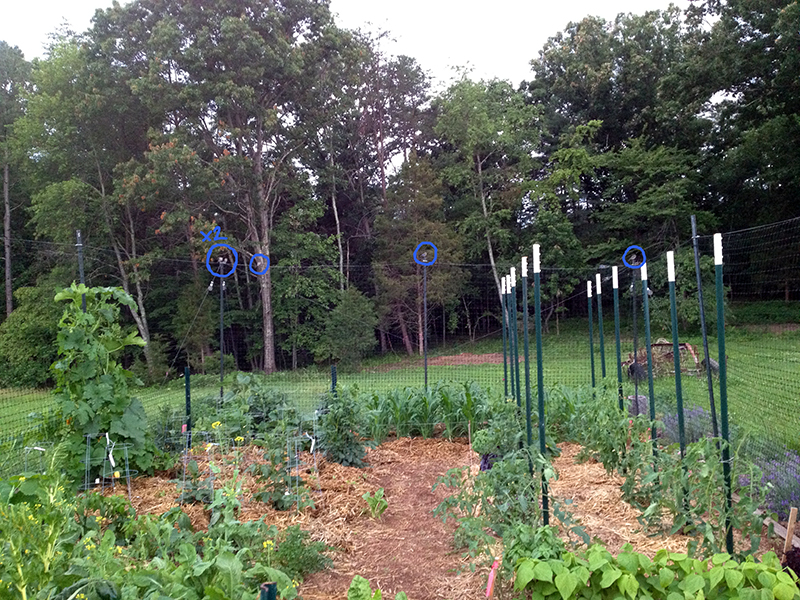
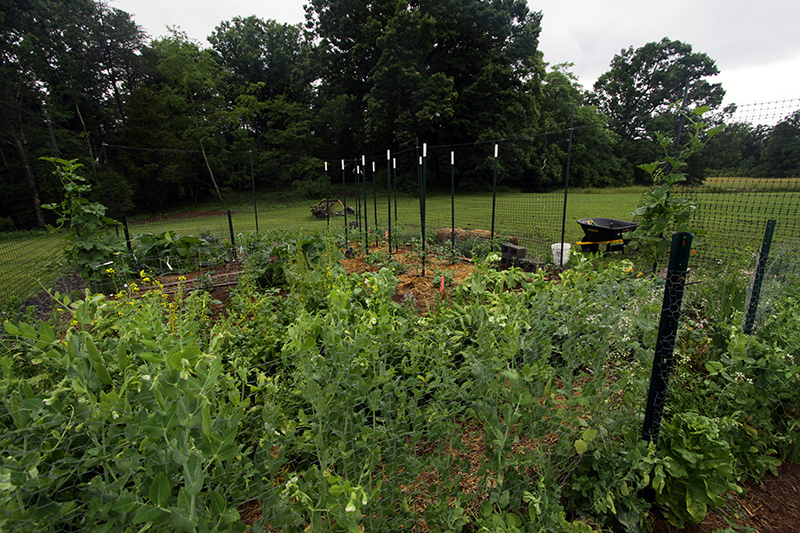
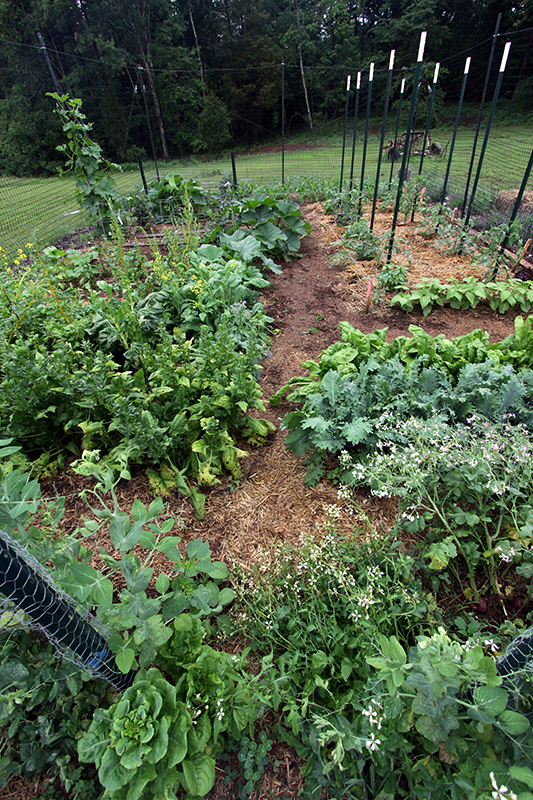
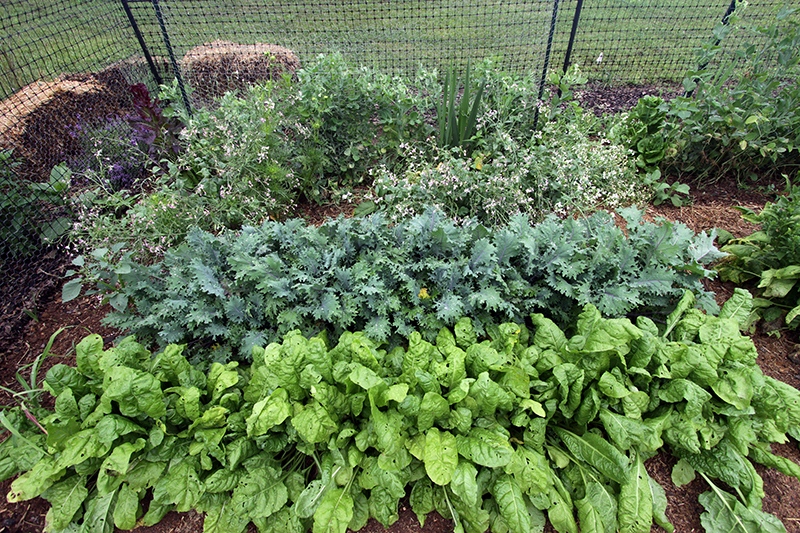
Starting in the foreground of the shot above, I have various lettuces and flowering arugula growing around the sugar snap pea. supports. Then, up the right side of the path are a row of zinnias, the peas, flowering radishes, Red Russian kale, Lucullus Swiss Chard, some dill, and the entry path. Then come some Dragon’s Tongue beans, then my patch of 11 tomatoes underplanted with various basils, a row of mixed wax, green and purple beans, and finally my Glass Gem corn. Up along the fence on the right side are sunflower and cosmos seedlings, and tucked here and there are tomotillos, hyacinth beans, poppies, and a volunteer squash.

Up the left side of the path are, out of view of this photo, sweet peas at the fence, Victoria rhubarb, another row of zinnias, more sweet peast, radishes, then overwintered spinach that’s about to be ripped out and replanted, cilantro, parsley, borage, thyme, a row of red Swiss Chard, overwintered bok choy and yellow chard, blueberries, strawberries, then a row of mustard, followed by rows of arugula and mache. Then some rogue ruffled kale seedlings, and about eight pepper plants. After that we get into the dahlia forest, interplanted with rows of zinnias, followed by the cucumber trellis, a squash, then even more dahlias, nasturtium seedlings, and my mint patch. Whew!

IMG_3082Web

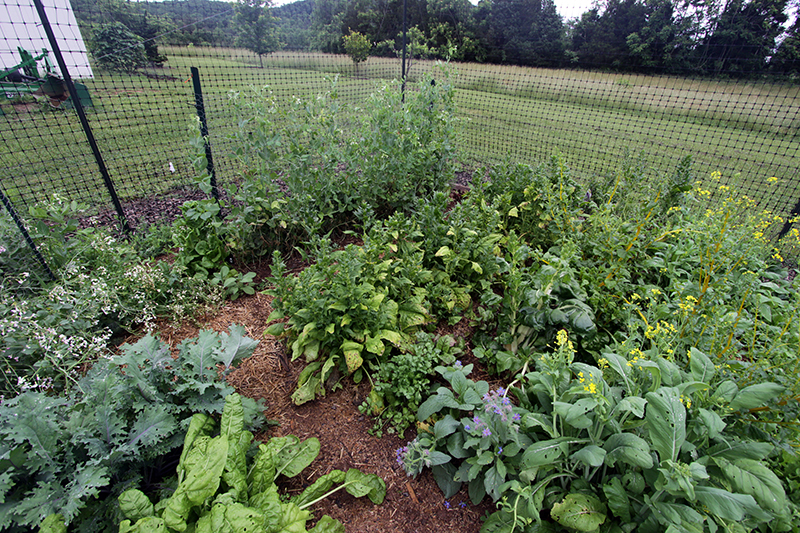
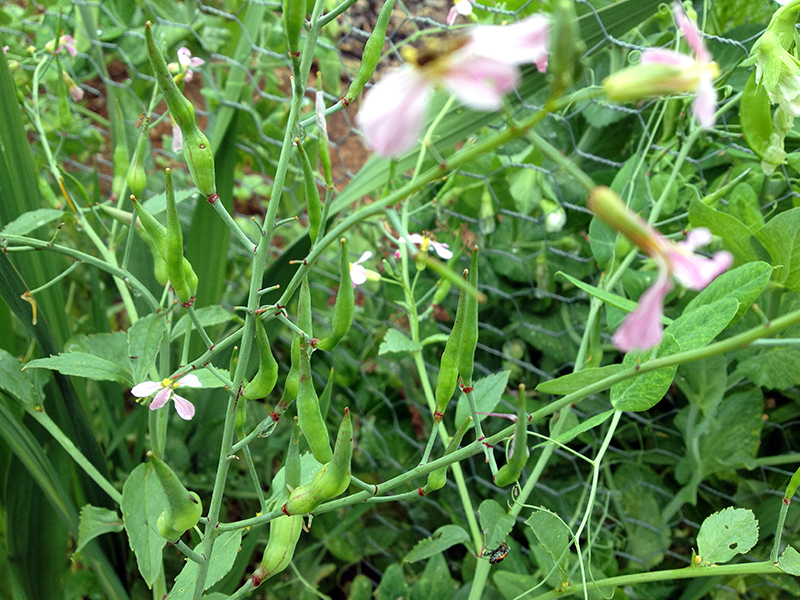
Let’s get closer. Up above are the various greens. The blue flowering plants are borage, and the mustard is blooming yellow. The radishes on the left have beutiful light pink flowers, and they’ve made “radish beans.”

RadishBeansWeb

These radish seed pods are actually more delicious, to me, than the radishes. I am glad I let this crop go to seed and discovered a new treat.

IMG_3081Web

From the top: Peas, radishes, Red Russian Kale, Lucullus Swiss Chard

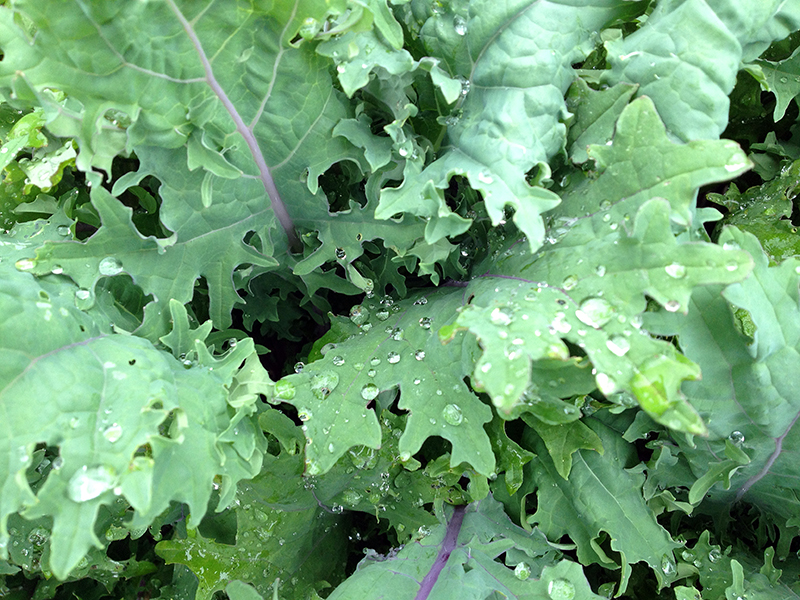
KaleWeb

I find Red Russian kale to be one of the most beautiful plants I grow. Every thing about it, from the shape of the leaves to their color, pleases me. Last year my first seeding was preyed on by some sort of stink bug, but this year that bug has held off long enough for me to get a few leaves of my own. I suspect that it will only be a matter of time until the kale falls victim to some other bug, though. Such is the nature of (my) organic garden.

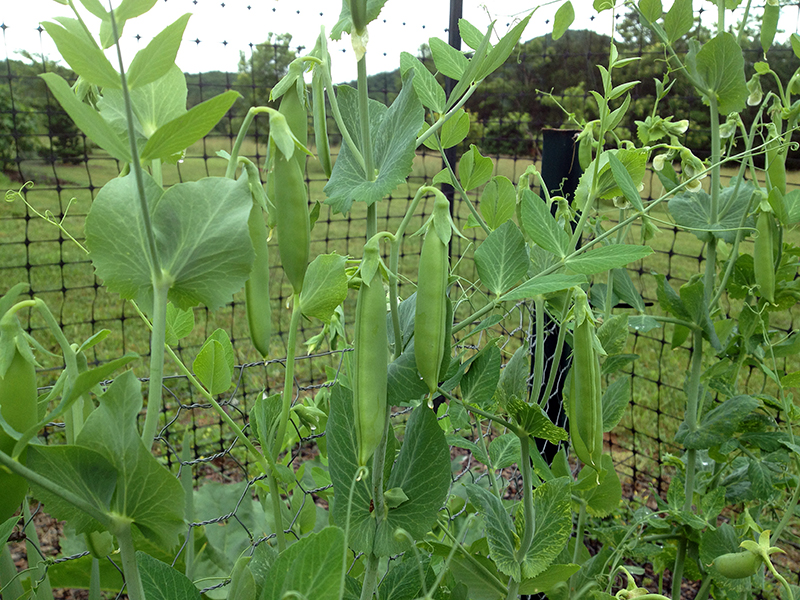
SnowPeasWeb

The snow peas are finally coming on. I am puzzled by snowpeas. The seed packets say to sow here in February or March. Well, February just seemed brutal to try to get something to grow, so I waited and sowed in March. It was a month before seedlings emerged. I didn’t get a great germination rate (they were old seeds), so I interplanted with new seedlings in April. These newer plants quickly caught up to the earlier-seeded siblings, just as of of my favorite gardening books said they would. I think this spring’s weather, which has alternated between highs in the mid-90s and being downright chilly, has the peas in a tizzy. I’ll be lucky to get a few delicious handfuls, and that will be it before I rip them out to plant something else. Central VA just doesn’t have the climate for growing these cool-season crops.

Up next: the rest of the garden…

Things that go bump in the night

June 12th, 2013 § 1

Last night, right in the middle of one of my usual nightmares, I was awoken by a terrifying sound. It was coming from directly in front of and below my bed, and sounded like heavy footsteps right on my front porch. I lay silent, blind eyes open in the dark. Then I heard it again, several loud thumps, booted feet just outside.

Cold adrenaline filled my veins in the time it took to sit up and and turn on the light by the bed. It was just after 1:00 a.m. I opened my nightstand and took out the can of pepper spray that’s always there. For an ironic second I remembered the recent day I visited my friend Aaron and he showed me a small Glock pistol, suggesting it would be a good thing to have stashed in a bedroom drawer. He, like most of the men who know how I live out here, wants to see me armed.

I crept out of bed and over to the “oh, shit” floodlight switch on the wall. I’d asked for this switch to be installed when the house was built for just this sort of event, so if I was ever feeling threatened I could flood the yard with light without leaving my bedroom. I turned on the lights, praying they’d be enough to frighten this person off my porch, and stood listening.

It was quiet.

I moved to the top of the stairs, and undid the safety clasp on the pepper spray.

Still quiet.

I steeled myself for a confrontation, and walked down the stairs and over to the front door. I looked out the sidelight into the night.

And there was a raccoon, doubled over at the end of the walkway, eating something. And instantly I knew what it was. I’d been using some heavy glass eggs in the chickens’ nesting box to try to induce one of them to go broody. I’d removed them yesterday because a real chicken egg had cracked, coating the glass eggs with raw yolk. I’d stashed these eggs in a planter on the front porch until I could take them in to wash, and of course I forgot about them.

So this raccoon had managed to get a glass egg out of the planter, no doubt creating the crashing sounds I heard on the porch, and was trying to eat it. My glass egg, which by the way, was very pretty and kind of pricey and sold as a decorative objet at fancy boutique store downtown.

I opened the door, and the raccoon started running down the driveway. With my glass egg. Dammed if that little bastard was going to give me the fright of the year and make off with my home decor. I ran after the raccoon, down the driveway in my pajamas and sock feet, making my best frightening noises.

And when the raccoon got to the road, he dropped my glass egg and disappeared into the tall grass. Triumphant, and oh, so relieved, I picked up the raccoon-spit covered egg, returned home, and deposited it with the others in a bowl, inside.

Then I went back to bed, where I couldn’t sleep from the stress hormones still zinging in my bloodstream and the nausea they induced. I lowered the air conditioning in the room by four degrees, and opened a fairly technical book on perennial pruning to try to bore my mind quiet. My cat jumped on the bed and sat watching me, her toes touching my flank, as she conducted some of my fear energy away.

And when my eyes began to close, she jumped off the bed, I turned off the light, and we both went back to sleep.

GlassEggWeb

Going again

June 8th, 2013 § 0

Bluebirds2Web

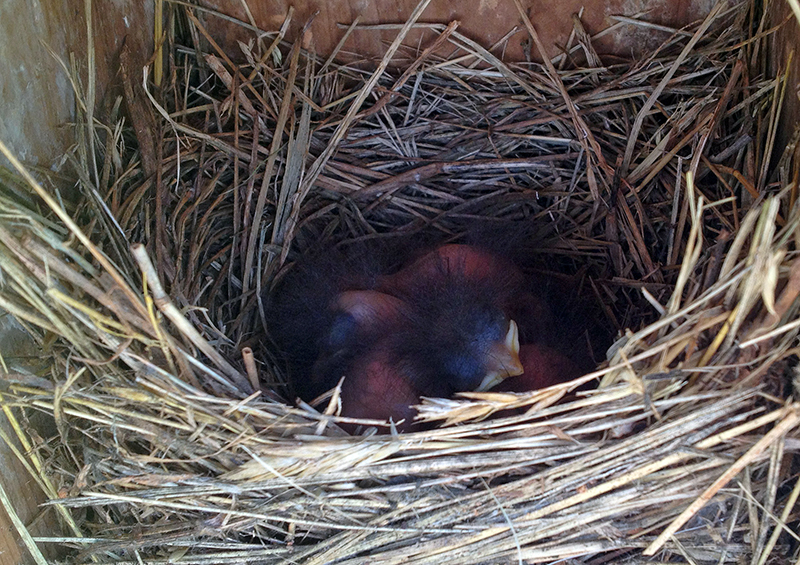
Looks like round two of the 2013 bluebird babies have arrived. There were five eggs in here. I can’t tell yet if they’ve all hatched.

Bluebirds3Web

In other news, I am fairly certain I saw all five members of the previous hatch lined up on the fence near their nestbox. I also saw six bluebirds at once in my peach tree, some of them colored like juveniles. Apparently it’s not uncommon for juveniles to hang out near their parents for a while after fledging.

Let’s hope this group is as successful.

What big teeth you have

June 7th, 2013 § 0

Despite how it looks, this story doesn’t have a Disney ending. Stop reading now if topics such as the natural order, predation, working farm dogs, and death are ones you’d rather not read about right now.

NotadisneystoryWeb

For the last week or so the garden around my house has been plagued by a nocturnal visitor. Every young and vulnerable plant fell victim, including new seedlings of rare, mail-ordered zinnias, the newest shoots of dozens of star gladiolus that were just emerging, small bedding coleus, and young red chard transplants that I’d been watering three times a day to get them to take—basically everything I’d lined up to provide summer interest in my garden. As any gardener knows, there is nothing more disheartening than to spend money and time fussing over young plants just to come out each morning find them eaten to the nub.

RedChardWeb

Because of the pattern of damage, I suspected a rabbit. My suspicion grew Wednesday morning when Tucker went nuts in the front garden, trying to climb inside some of the larger shrubs. I knew he was in pursuit of something, but I feared that in his frenzy I’d lose even more plants. So I called him off and kept him inside.

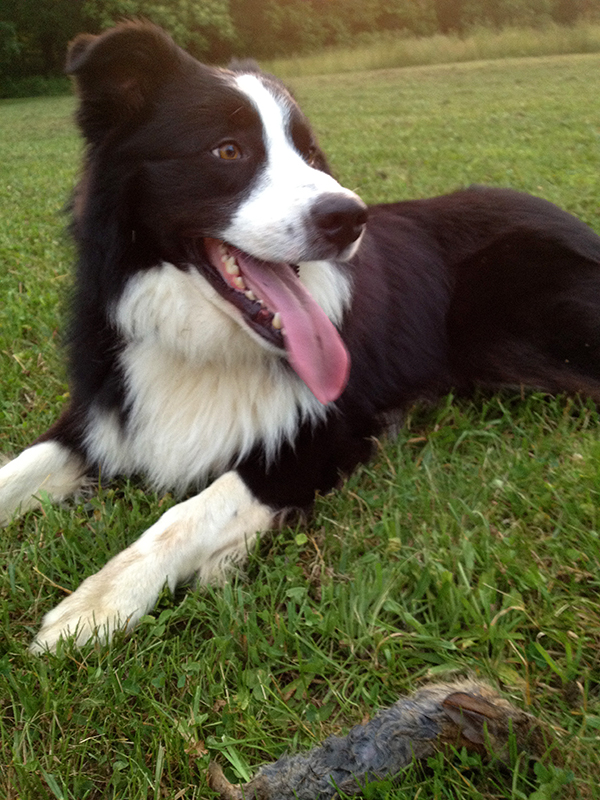
That night, however, he was outside with me and spent hours working something near the corner of the well house. Around sunset I went outside and found the scene above. There was no going back—the rabbit had already sustained significant damage.

I like this photo below because it reminds me of all those classic paintings of working dogs with their quarry: the labs with their ducks, spaniels with grouse and pheasant, hounds with deer and boar and bear, and terriers with ground-dwelling varmints.

SelfSatisfiedHunterWeb

Because I think it is important to reward Tucker for this hunting behavior, which is exactly the kind I want him to exhibit. So I praised him and left him with his kill. And he was oh, so proud. When I went to collect him for bed, at almost 10:00 p.m., he was crunching the last of the bones.

CleanupWeb

Yes, the rabbit was adorable and I think they are lovely creatures. I enjoy seeing them in the fields ands try my best to not hit them when they dart in front of my car. But this rabbit picked the wrong salad bar, and I am proud that I have an English Shepherd that is pulling his weight around the farm as a working dog as well as a pampered pet. Like all the happiest dogs, he has a job and it is a joy to see him able to fulfill his nature in such a helpful way.

Early June evening

June 3rd, 2013 § 0

JuneSunsetWeb